

CHEAT SHEET: Every Argument For & Against Trump’s “SAVE America Act” (‘Voter I.D.’)

I read U.S. President Donald Trump’s SAVE America Act – so you don’t have to. I then studied all sides of the debate surrounding the bill.
Surprise, surprise! Neither side is telling you the full story on this one.
Below I lay out the strongest arguments for and against the bill. Not the dumbed-down version. Not the social media version. The real arguments. Made by serious people.
And then I’m going to shut up and let you decide.
By the way: your news feed isn’t built for this. It’s built to make sure you only hear from whichever side your social media algorithm thinks you like. Smart people on all sides are making big claims. And most of it is designed to make you feel something before you know something.
I want to flip that. I want to give you what you need to handle the noise — and make up your own mind.
Along the way here’s what I discovered:
The arguments FOR this bill are short, simple and easy to grasp – because they are designed to appeal to common sense. After all, nobody wants undocumented immigrants stealing elections. So I could explain the proponents’ position in fewer words.
The arguments AGAINST the bill are more complex — because they are rooted in implementation challenges, real-world database failures, legal theories and the law of unintended consequences. It took me more words to explain the objections.
That said – a longer argument is not necessarily a better one, and a shorter argument is not necessarily a more truthful one. There are important points to consider on both sides.
But in an information ecosystem that rewards speed over substance, “longer to explain” usually means “never gets heard.” So please take time to study both sets of arguments carefully.
If you’re only hearing one side of this debate, it’s not because the other side doesn’t have a case. It’s because someone decided you shouldn’t hear it.
CONTENTS
Below you will find the best of both sides arguments related to the following questions:
The Necessity Question
The “Race & Gender” Question
The “Access To Paperwork” Question
The Workability Question
The “Federal v State” Question
The “Principled or Political” Question
Blind spots on both sides
5 Things to Know Before You Read
President Trump has called this bill his “number one priority.” He has threatened to block every other piece of legislation — including a housing bill that passed the Senate 89-10 — until it reaches his desk.
The Senate voted 51-48 on March 17 to start debating the bill. Republican Lisa Murkowski was the only GOP senator to vote no. Thom Tillis (who opposes killing the filibuster for this bill) was notably absent. The Senate held a rare weekend session to continue debate. As you read this, we are heading into Week 2 of that debate.
U.S. Senate Majority Leader John Thune has said he doesn’t have the 60 votes needed to pass it. The debate could last weeks.
That’s why some people call this a “messaging bill” – meaning the bill probably won’t garner enough votes in the U.S. Senate to become law. But it will help Republicans advance their “message” that they believe Democrats are election cheats.
Even if it doesn’t pass, the debate itself matters — for the future of voting, for the future of the filibuster, for the 2026 midterms, for the 2028 Presidential elections – and for what kind of democracy we want to be.
Quick Background
The vast majority of Americans support “voter ID” – meaning you should show a government-issued photo ID at the polls to prove you are who you say you are. Almost everyone agrees voters should be verified.
The question isn’t whether. It’s how — and what it costs.
The SAVE America Act has multiple requirements that go beyond simple voter ID.
That’s where the controversy comes in.
The Safeguard American Voter Eligibility (SAVE) America Act would require you to show a birth certificate, hospital record, passport or naturalization certificate — proving you’re a U.S. citizen — when you register to vote. (Your driver’s license and even most REAL IDs won’t work – because they do not indicate citizenship status.)
Then, at the polls, you’d need a photo ID approved from a narrow list – stricter than existing voter ID laws in every state but Ohio. For example, student IDs would be out. Utility bills would be out.
In states that have been sharing their voter rolls with DHS since mid-2025, a driver’s license could work. But in states that haven’t shared voter rolls, you’d need to show proof of citizenship again at the ballot box.
On top of that, the bill would let the Department of Homeland Security (DHS) check voter rolls against the DHS SAVE database. Online and mail-in voter registration would be eliminated or curtailed in most states.
If an election worker registered a voter without the official federal government approved paperwork, that worker could go to prison.
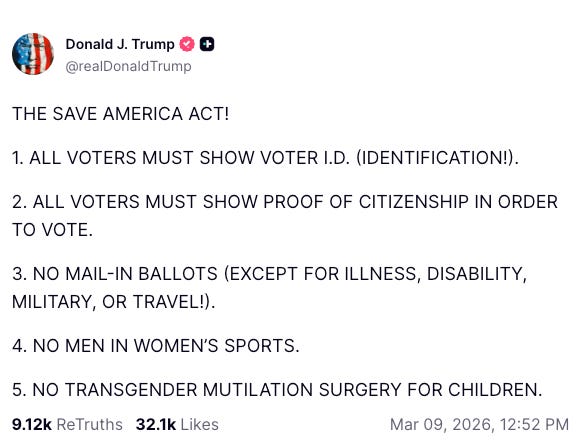
Trump is pushing to add more provisions, some of which appear to have little or nothing to do with elections.
One amendment that would ban mail-in ballots.
One would bar transgender athletes from women’s sports
The last would block gender-affirming surgery for minors.
1. The Necessity Question
Is noncitizen voting a real threat that demands new “proof of citizenship” requirements? Or is it a made-up crisis whose “solution” would block millions of legitimate, eligible Americans from voting?
The Case For the Bill
Republicans say that tens of millions of non-citizens poured into the United States under President Joe Biden – an unprecedented invasion. Therefore the federal government must take unprecedented steps to prevent this tidal wave of foreigners from voting. Only citizens should be able to vote. If we open the voting booths to anyone and everyone, we won’t have a country.
Today’s “safeguards” won’t cut it.
Right now, when you register to vote in most states, you check a box. You swear you’re a citizen under penalty of perjury. But in many cases, nobody independently verifies it. (NOTE: Some states already cross-check registrations against government databases, but the bill’s supporters argue those checks are inconsistent and full of gaps.)
Supporters of this bill say the whole operation runs on “the honor system” — and that’s not good enough. Not anymore. Not with this many non-citizens running around. Not for something this important.
Pro-SAVE America Act champions point to documented incidents of voter fraud:
Red states have found noncitizens on their voter rolls — 20 in Georgia, 403 in Louisiana. But blue states may not even be looking.
Even if the numbers are small, every fake vote cancels out a real one.
And if we can’t say for sure how many noncitizens are registered — because the system never checks — then maybe the problem isn’t that fraud is rare. Maybe the problem is that we’re not looking closely enough.
They also invoke common sense.
If you need an ID to get on a plane, buy Sudafed or open a bank account, why wouldn’t you need one to vote?
Almost every other democracy that has noncitizens living within its borders has some way to check citizenship before people vote. America is the odd one out.
According to Pew Research, 83 percent of Americans — including 71 percent of Democrats and 76 percent of Black voters — support voter ID.
The argument at its strongest: We’re not asking for anything crazy. We’re asking for what most Americans already think is happening. And when they find out it’s not happening, they agree it should be.
The Case Against the Bill
Opponents say the SAVE Act imposes a massive, unworkable solution on 160 million U.S. citizens to fix a tiny, almost non-existent problem.
Worse than that, many believe the bill’s proponents are exaggerating this fake crisis just to make it harder for vulnerable populations to vote.
Opponents agree that only citizens SHOULD vote. They just don’t believe noncitizens ARE voting very often, if at all. And every big, state-by-state check backs them up:
Georgia looked at 8.2 million registered voters. Found 20 noncitizens. Nine had voted. That’s approximately 0.00024% non-citizens caught per registered voter.
Utah checked 2.1 million. Found exactly one noncitizen who registered. That person never voted. Zero impact on election results.
Louisiana‘s Republican Secretary of State Nancy Landry found 403 noncitizens out of 2.96 million voters going back to the 1980s. 83 had voted — over more than 40 years. She said flat out: “Non-citizens illegally registering or voting is not a systemic problem in Louisiana.”
The Heritage Foundation’s own database — the one cited most often on conservative media — has roughly 99 total cases involving noncitizens since 2000, according to the libertarian, conservative-leaning Cato Institute’s review. Not per year. Total. And many of those were green card holders who got bad information from government offices. Not coordinated attempts to rig an election.
Anti-SAVE America Act opponents argue it’s already a federal crime for a noncitizen to vote. The current consequences are severe:
Prison time
Deportation
Permanent ineligibility for citizenship
The law already exists. It’s already enforced.
Opponents say: this bill would change the rules for 160 million registered voters to fix a problem created by a few dozen unlawful voters. That’s not security. That’s overkill — and the people who’ll pay the price are millions of legitimate, eligible voters who inevitably will end up blocked from casting their ballots.
2. The “Race & Gender” Question
Is this bill neutral in its impact on race and gender – despite Democrats’ wild claims to the contrary? Or is this bill a sneaky “Jim Crow 2.0” attack on black voting rights and women’s access to the ballot?
The Case For the Bill
Supporters say this is a simple security measure that faces pushback for only one reason: Democrats benefit from a system with no verification. They reject the idea that this bill has anything to do with race or gender. They say the “Jim Crow 2.0” label is a cynical smear — a predictable play from the same Democrats who call everything racist when they don’t like it.
Their core arguments:
The bill applies the exact same rules to every single American – regardless of race, gender or party. One standard. One set of documents. No carve-outs. No exceptions based on skin color in either direction. That’s the opposite of discrimination.
The polling backs them up. According to Pew Research, 82 percent of Hispanic Americans and 76 percent of Black Americans support photo ID requirements for voting. These aren’t fringe numbers from a conservative pollster. These numbers represent supermajorities of the very communities Democrats claim to be protecting.
Prominent Black Republicans have been blunt about what they see as the real insult. U.S. Representative Burgess Owens called the racist framing “the soft bigotry of low expectations” and said it was “wildly insulting” to suggest that Black Americans can’t get an ID.
U.S. Senator Tim Scott said the comparison to Jim Crow was “hogwash” and pointed to the bill’s broad, bipartisan public support as proof it is common sense, not bigotry.
On gender, supporters say the Democrat’s claim that “69 million women will be disenfranchised” because they changed their maiden name is a deliberate scare tactic.
White House Press Secretary Karoline Leavitt said there is “zero validity” to the claim, claiming that women who are already registered are entirely unaffected. (FACT CHECK: The bill itself is actually silent on this point.)
For those who need to register or update, the bill allows them to sign a “simple affidavit” confirming that the name on their birth certificate is their previous name.
The bill’s sponsor, Rep. Chip Roy, wrote in The Federalist that the “69 million” figure is “a statistical sleight of hand” that “purposefully ignite[s] fear” by lumping in millions of women who are already registered and already have updated documents.
Supporters also push back hard on the turnout argument:
U.S. Senator Rick Scott said bluntly: “This idea that [voter ID] is going to suppress votes … that has never happened anywhere.” He pointed to Georgia, which saw record turnout after passing its 2021 voter integrity law — despite Democrats calling that bill “Jim Crow 2.0” at the time.
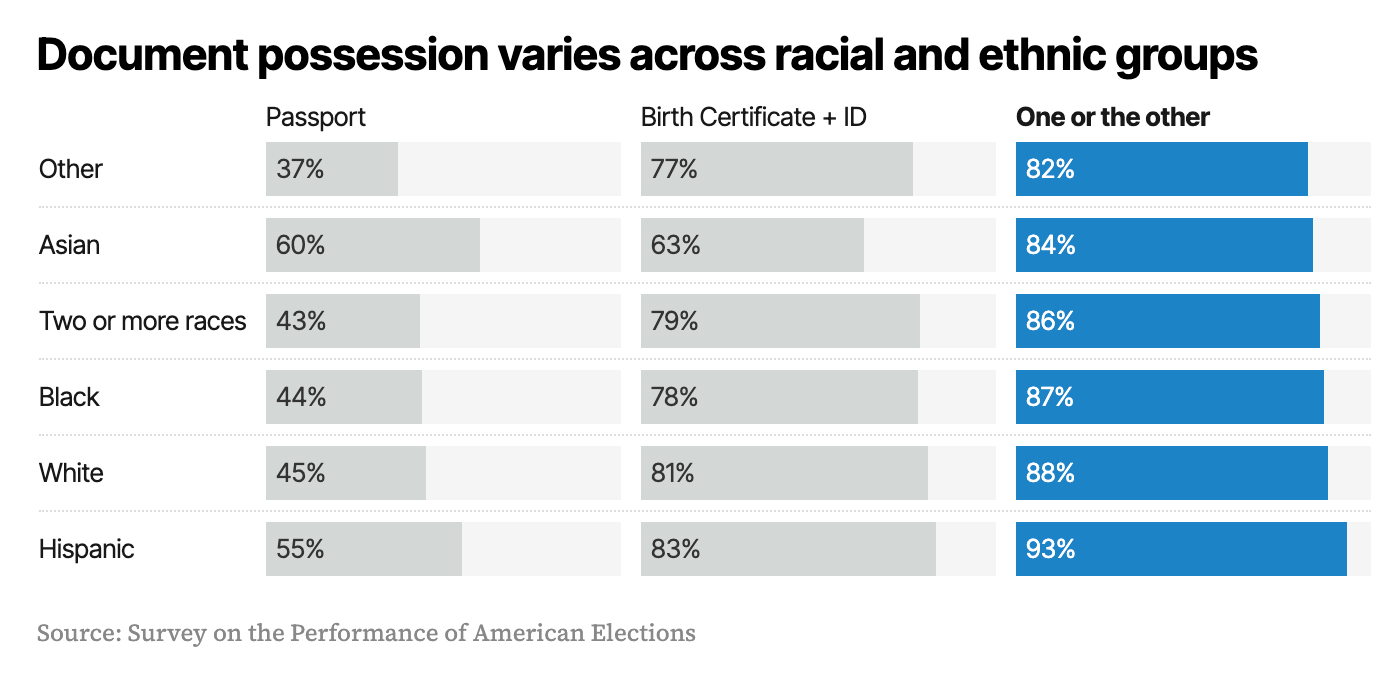
The Bipartisan Policy Center — a nonpartisan think tank — confirmed that Black respondents are about as likely as white respondents to report having documentary proof of citizenship. Ironically, Hispanic voters had the highest reported rates of any racial group.
The argument: Calling this racist or anti‑woman insults minority voters who already have ID. If opponents have to lie about the bill to beat it, maybe their real problem is with voter ID itself – because they’re trying to cheat.
The Case Against the Bill
Opponents identify other studies and surveys that cast serious doubt on Republican claims:
Opponents say you don’t have to call the bill’s supporters racist to acknowledge that the bill would have racially lopsided consequences. Intent is one thing. Impact is another. And the data they point to on impact is damning.
The Brennan Center found that 11% of Americans of color lack ready access to documentary proof of citizenship, compared to 8% of white Americans. That gap represents millions more people of color locked out of the registration process.
According to YouGov, only 34% of Black Americans hold a current U.S. passport — compared to 42% of white Americans and 55% of Hispanic Americans. Civil rights groups back up this math.
The Native American Rights Fund warns that the bill would be devastating for Native American voters. The bill claims tribal IDs will work — but it requires them to include “place of birth,” which tribal IDs do not include. Native citizens in rural and remote areas fear they would have to travel more than 100 miles — or even get on an airplane — just to reach a government office, during weekday business hours, to present the required paperwork.
Opponents point to a growing body of peer-reviewed research.
A 2018 study from the University of California San Diego — one of the first to analyze certified votes nationwide across multiple elections — found that strict voter ID laws doubled the turnout gap between whites and Latinos in general elections. It nearly doubled the white-Black turnout gap in primaries. The researchers noted: “By instituting strict voter ID laws, states can alter the electorate and shift outcomes toward those on the right.”
New evidence from Georgia — the very state supporters hold up as proof voter ID works — tells the opposite story. Federal court filings using 2024 election data show that SB 202 widened the racial turnout gap. Black voters were 25 percentage points more likely than white voters to have their mail ballot applications rejected. As a result, Black mail ballot use plunged from 29% in 2020 to 5% in 2024 — a 23-point drop. Nearly 130,000 Black voters lacked valid or matching IDs in their registration files.
In theory, these requirements are color blind. But in practice, opponents say they have had a predictably detrimental effect on black voters.
On gender, the numbers are stark. According to Pew Research, 79% of married women take their spouse’s last name. The liberal Center for American Progress estimates that 69 million women have a birth certificate that doesn’t match their current legal name.
Supporters say “don’t worry, because the affidavit fixes everything.” Great in theory!
But in practice, opponents say: one state already tried this – and it was a disaster for women.
In New Hampshire, which enacted one of the first proof-of-citizenship laws in 2024, a voting rights coalition tracked nearly 250 voters turned away during the 2025 elections — the majority for insufficient documentary proof of citizenship, including name change documentation.
In Bethlehem, New Hampshire, an election official reported rejecting 25% of registration applicants — all women with maiden-name birth certificates who lacked name change proof.
One Concord election official testified that she had to turn away a recently-divorced woman who had changed back to her maiden name but lacked proof. Her ex-husband could vote. She could not.
Ms. Magazine reported that the burden falls hardest on women already facing economic barriers: according to the National Women’s Law Center, Black, Latina and Native American women experience poverty at more than twice the rate of white, non-Hispanic men — making the costs and inconvenience of obtaining a passport or replacement documents a genuine obstacle, not an inconvenience.
The civil rights community has spoken with one voice.
The NAACP Legal Defense Fund called the bill “disingenuous, discriminatory and rooted in a continuously disproven narrative of voter fraud.”
The Leadership Conference on Civil and Human Rights, joined by more than 130 organizations, wrote that the bill would “exclude eligible voters — particularly Latino, Black, Asian American, Native Hawaiian, Pacific Islander and Native American citizens; married women who have changed their names; low-income people; and people with disabilities — from the electorate and our democracy.”
The Latino community has flagged that the bill would force over 36 million eligible Latino voters to navigate new bureaucratic hurdles. About 4 in 10 Latino citizens lack a valid passport and Latinos make up 34% of all naturalized U.S. citizens — many relying on naturalization certificates that are expensive and difficult to replace.
Senate Minority Leader Chuck Schumer summed up the critique: ”It’s Jim Crow 2.0. What they’re trying to do here is the same thing that was done in the South for decades to prevent people of color from voting.”
The argument: If the people without paperwork are disproportionately Black, brown, poor, rural, sick, elderly and female — and actual noncitizen voting is vanishingly rare — then this isn’t security, it’s a cynical voter purge.
3. The “Access To Paperwork” Question
Can every U.S. citizen who has the right to vote get the paperwork this bill demands? Or would the new paperwork requirements hit hardest the people who fought longest and hardest for the right to vote?
The Case For the Bill
Supporters say every citizen – with minimal effort – can get the required documents:
Birth certificates can come from the government (if they’re legitimate and were filed properly).
Passports come from the State Department.
Naturalization certificates are given out at the citizenship ceremony.
The paperwork exists. If you care about your right to vote, just get your papers together!
If you don’t have them, you should get them. It’s a one-time thing when you register – plus a reasonable added layer of security when you vote. That’s it. (Besides, it is better to check everyone’s documents up front – rather than trying to verify citizenship after the fact, using government databases that might be outdated or full of mistakes.)
Other points:
The bill has backup options. If you don’t have the main documents, you can use other forms of proof. States still get some say in how they carry it out.
Supporters say the “21 million people locked out” number is overblown. “Don’t have it handy” isn’t the same as “can never get it.” Anyone who cares about their right to vote can and will figure it out.
They also push back on claims that this bill targets minority voters, calling that framing insulting. Their argument: assuming that a voter is too dumb or lazy to get an ID just because they aren’t white proves liberals are the real racists.
At its strongest: This is about respecting the vote enough to verify it. We require ID for things that matter way less than this.
The Case Against the Bill
It’s a cruel joke to pretend that the same ID you use everyday to “get on a plane, buy Sudafed or open a bank account” would be good enough to vote under this bill.
It won’t be! Your drivers license won’t cut it. Without additional proof of citizenship documentation backing it up, a drivers license doesn’t count under this bill.
Even your REAL ID — the one the government now requires to board a plane, which took 20 years to roll out — doesn’t count under this bill. (Not unless it has “U.S. citizen” printed on the front, which right now is only an option – not standard – in five states: Washington, Vermont, Minnesota, Michigan and New York.)
So this isn’t about simple voter ID. This is about suddenly making every U.S. voter get PASSPORT level identification – a whole different level of ID than you use to buy a beer.
Two major research groups have tried to measure how many Americans would struggle to meet these new requirements.
The Brennan Center for Justice — a voting rights advocacy group that opposes the bill — surveyed citizens and found 21.3 million don’t have a passport, birth certificate or naturalization papers readily available.
The Bipartisan Policy Center — a nonpartisan think tank — ran its own analysis and put the number even higher: roughly 28 million.
The two groups used different methods. But they point in the same direction: tens of millions of U.S. citizens potentially blocked from the ballot box.
The people facing barriers include vulnerable voters – in both parties:
Rural voters who live hours away from government offices that can issue necessary documentation
Married women who changed their names when they got married and don’t have proof of citizenship documents that match their husbands’ last names
Older Americans – the most dependable voters – who may have been born at home or in rural hospitals with incomplete records. They may no longer even have valid drivers licenses.
Young voters registering for the first time, far from home, whose student IDs won’t be enough
Low income voters who can’t afford the fees, time off work or travel costs to get “passport level” proof of citizenship documents
Poorly informed citizens navigating a complicated and confusing bureaucracy
These are the same groups that have fought the hardest, for the longest, to have a voice at the ballot box. They are the people who are most likely to be overlooked by the government if their voice isn’t heard because their vote doesn’t count.
To make it worse: three states already tried similar schemes – with awful results.
KANSAS: Kansas is the only state that actually tried implementing this law at scale. Starting in 2013, they required proof of citizenship to register to vote. During the five years the law was in effect before it was overturned by a judge, more than 31,000 U.S. citizens who had every right to vote were blocked from registering. The number of noncitizens they caught? Thirty-nine. Only 11 of them had actually voted over the course of two decades. But tens of thousands of lawful U.S. citizens had their right to vote denied in that state.
ARIZONA: Arizona has required citizenship verification since 2004 — but it uses a database-matching system rather than requiring physical documents like the SAVE Act would. Even with that lower bar, according to the Institute for Responsive Governance, an estimated 258,000 voters have been blocked from state and local races because their citizenship couldn’t be confirmed through the database. Many turned out to be citizens caught in a data mismatch. (NOTE: SAVE Act supporters argue this actually proves their point: database-matching is unreliable, which is why document-based verification is better. Critics respond that the outcome — tens of thousands of citizens blocked — is what matters regardless of method. The case is still in litigation.)
NEW HAMPSHIRE: New Hampshire tried a proof-of-citizenship rule more recently. In the very first election under the new rules, voters got turned away at the polls. According to voting rights monitors, hundreds of potential voters were blocked – including women whose birth certificates didn’t match their married names. One woman was sent home twice in a single day. This is the exact thing SAVE America Act supporters said would never happen.
At its strongest: This isn’t theory. We tried it. It blocked hundreds of citizens for every noncitizen it caught. That’s not a trade-off any democracy should accept.
4. The Workability Question
Is this bill ready for the real world? Or would it throw the system into chaos right before the midterms?
The Case For the Bill
The SAVE Act would kick in as soon as it’s signed. The Election Assistance Commission would have 10 days to send guidance to every state.
Supporters say the tight timeline is the point: it forces states to act instead of stalling. The sheer number of noncitizens who have flooded our country constitutes a national emergency – requiring bold action to secure our democracy from foreign interference at the voting booth. Deep state obstructionists and blue state opponents need to be run over and forced to do the right thing.
Proponents say opponents are deliberately making this sound harder and more complicated than it actually is.
The bill has backup options for people who don’t have the main documents.
Federal agencies — especially DHS — would help states check voter rolls using the SAVE database.
The same forms, the same rules, everywhere. Simple.
There’s also a practical argument: checking documents up front, at the point of registration, is actually easier for election offices than trying to maintain accurate databases after the fact. One clean check at the door beats an endless game of whack-a-mole with bad data.
The argument: The tools exist. The documents exist. What’s missing is the will to use them.
The Case Against the Bill
Opponents say there is zero chance a law this sweeping could be implemented on this timetable. They say it is totally impractical – bordering on ludicrous – to say otherwise.
The U.S. Conference of Mayors — a bipartisan group of Republican and Democratic mayors — wrote to the Senate opposing the bill on pure nuts-and-bolts grounds. They didn’t mince words. They said the bill would “insert chaos into our election system,” dump an “unfunded burden on state and local governments” and force huge changes to how we register voters “shortly before the midterm elections.”
These aren’t political pundits. These are the local elected officials who actually oversee and run elections.
Also, there’s the SAVE database — the DHS system the bill relies on to check voter rolls. It’s already being used in some states. And it’s already getting things wrong.
Denton County, Texas: 84 voters flagged as possible noncitizens. When officials actually checked? At least 12 — more than 14% — were American citizens.
Missouri: State officials acted on the system’s flags before checking them, telling counties to block flagged voters. County clerks reported that in many cases, the people flagged turned out to be eligible Americans.
Multiple states: According to the Brennan Center, DHS has had to send corrections to several states after the system wrongly tagged citizens as noncitizens.
The Bipartisan Policy Center found that even in states already using the system, it flagged a big chunk of the people who had already shown proof of citizenship when they registered.
One Texas election administrator summed it up in three words: “Not ready for prime time.”
There’s one more thing. Right now, 42 states let you register to vote online. Under this bill, that would be out the window.
According to multiple election law analyses, the SAVE Act would effectively end online registration in most states — because you can’t upload an original birth certificate through a website.
The Voter Participation Center, a nonpartisan group focused on voter access, analyzed federal election data and found that 83 percent of current voters used registration methods that would be restricted or eliminated under this bill.
All of this would happen now — before the bill would massively expand the SAVE database’s role. With no new money. No phase-in period. And criminal penalties for the officials who have to make it work.
That’s not a tweak to the system. That’s rebuilding it from scratch. In the middle of an election year.
The whole idea would be laughable – if the threat were not so serious.
The argument: The people who actually run elections say this bill would crash our voting system. The database at its core is already misfiring. Blowing up online registration in an election year is chaos, not reform.
5. The “Federal v State” Question
Which level of government should control elections — federal or state? And what happens when local officials face prison time for paperwork mistakes?
The Case For the Bill
The U.S. Constitution gives Congress the power to set rules for federal elections. Supporters say that’s exactly what this bill does. Federal elections are a federal matter. Congress has every right to create one clear, national standard for proving you’re a citizen before you register.
They point out that the U.S. Supreme Court has never struck down a federal proof-of-citizenship requirement — only state-level ones. In Arizona v. Inter Tribal Council of Arizona (2013), the Court ruled 7-2 that Arizona couldn’t pile its own citizenship-proof rules on top of the federal voter registration form. That’s the whole reason the SAVE Act was written the way it was; it rewrites the federal voter registration law itself, closing the gap the Court left open.
This bill invokes the same kind of federal “elections oversight” authority that Dr. Martin Luther King relied upon when he marched for the 1964 Voting Rights Act.
Supporters say Congress is continuing to do what the U.S. Constitution intended: setting a national standard for national elections.
When it comes to expanded criminal penalties for election workers, supporters make three points:
Accountability: Officials have to follow the law. Period.
Teeth: Penalties that can’t be enforced are meaningless. If there’s no consequence, there’s no compliance.
Clarity: Clear federal rules actually protect good-faith officials by telling them exactly what’s required — no guessing.
The argument: The Constitution gives Congress this job. The SAVE Act finally does it. Clear national rules with real penalties are the only way to make sure every federal ballot is held to the same standard.
The Case Against the Bill
Opponents point out that the states have always run elections.
The U.S. Constitution gives Congress some say over federal elections. But states do the actual work – including deciding how to check who’s a citizen. That’s been the setup for more than 200 years. This bill would change it overnight. One federal standard. One federal database. And if your local election clerk makes a mistake? Federal criminal charges.
Critics on the left and the right say that’s not election reform. That’s Washington taking over your state and local elections.
As for the courts: opponents note the Court ruled on a statutory question — federal law vs. state law. It did not rule on whether a federal proof-of-citizenship mandate would survive challenges under the Equal Protection Clause or the 14th Amendment. Those questions have never been tested.
Furthermore, the Cato Institute — a right-leaning, libertarian think tank — has raised serious concerns. Cato’s Walter Olson has warned that the bill would hand “dangerous voter-screening power” to people appointed by the President, taking it away from local officials who actually know their communities. He noted that election workers could face criminal charges for paperwork errors — even if every single person they registered was a U.S. citizen.
Think about that. Under this bill, an election worker who signs up a citizen without the right documentation could be charged with a federal crime. That person could spend up to five years in prison. Not just for registering a noncitizen. For a simple paperwork mistake while registering an actual U.S. citizen.
The Bipartisan Policy Center calls this aspect one of the most dangerous parts of the bill. It would push election workers to reject anyone whose papers look even slightly off — because the alternative is risking prison. Nearly 60 election officials from both parties sent a letter opposing the bill for exactly this reason.
When the ACLU and the Cato Institute agree that something crosses a constitutional line, that is an anomaly worth paying attention to.
The argument: States have always run elections, this bill hands that power to Washington and a federal database. The threat of prison for paperwork mistakes will scare good clerks into blocking eligible voters.
6. The “Principled or Political” Question
Is this bill designed to protect elections fairly for everyone? Or is it meant to ensure that Republicans win more elections?
The Case For the Bill
Supporters say this is a simple security measure that faces pushback for only one reason: Democrats benefit from a system with no verification. Progressives want to shove illegal immigrants into our ballot booths and tell them to vote blue. But if these measures ensure that only U.S. citizens vote, the true choice of the American people will show up in the results.
And if that helps Republicans? That’s not cheating. That’s not partisan. That’s the system working right.
President Trump has said this bill would ensure that Republicans “never lose a race for 50 years.” His supporters say Trump is simply underscoring that the present corrupt system is rigged for Democrats to win by cheating. Clean up the rolls, and you will get what Americans actually want.
For people who see election integrity as the issue of our time, the political stakes are worth the fight. And anyone who opposes measures to check citizenship? Those people are crooks who want to keep cheating. Period. End of story.
At its strongest: If Democrats really believed only citizens were voting, they wouldn’t fear tougher checks. A party that fights basic citizenship checks is admitting it depends on illegal votes to win. The SAVE America Act simply strips away the cheating that props Democrats up.
The Case Against the Bill
Opponents have a simple answer: Trump’s bill is a purely partisan ploy to rig elections for REPUBLICANS – and the bill’s supporters keep saying the quiet part out loud.
U.S. Senator Mike Lee posted a chart showing Democrats favored to win the Senate in 2026 and wrote: “Let’s turn this around — by passing SAVE America.”
When a U.S. senator ties the bill to flipping midterm odds – and the president says the bill will keep his party in power for half a century — that proves that this law is not about nonpartisan election security. The bill is a scheme to knock out vulnerable, lawful voters who are more likely to vote blue.
But this bill hasn’t just divided Democrats and Republicans. It’s divided Republicans and Republicans.
U.S. Senator Roger Marshall said he’d nuke the filibuster to pass it. U.S. Senator John Cornyn — who spent years defending that same filibuster — suddenly flipped, writing that the SAVE America Act is more important. (Cornyn is also locked in a GOP runoff against Ken Paxton and waiting on a Trump endorsement that may depend on how hard he fights for this bill. Connect those dots yourself.)
Meanwhile, U.S. Senator Thom Tillis called the whole filibuster push “a foolish and lazy idea.” U.S. Senator Kevin Cramer said the SAVE Act isn’t worth blowing up the filibuster over. U.S. Senator Mitch McConnell won’t even vote for the bill. And Thune keeps saying what everyone already knows: he doesn’t have the votes.
What started as a debate about citizenship checks has turned into a food fight within the Republican caucus. Meanwhile Trump is holding the entire legislative process hostage — with other bills held captive to a bill the U.S. Senate can’t pass.
Someday there should be a grand, bipartisan bargain that balances tougher voter security with stronger voter access. But this extreme, unworkable train wreck of a bill is the opposite of what’s needed.
At its strongest: When backers brag this bill will lock in GOP power for decades, they’re admitting it’s about shrinking the blue‑leaning electorate – not neutral “integrity.” Even many Republicans can’t swallow that.
Blind Spots on Both Sides
Here’s how I see it.
The pro-bill side keeps waving the 83% who support voter ID stat around. But that poll asks about showing a state-issued photo ID — not handing over a birth certificate or passport. Those are two very different things. Treating them as the same thing isn’t an argument. It’s a bait-and-switch. And U.S. citizens who support common sense voter ID could pay the price. Not to mention: conservatives usually oppose national government overreach – like putting local election workers in federal prison over paperwork errors.
The anti-bill side keeps saying millions of women will lose their right to vote.They call it Jim Crow 2.0. But the bill creates hurdles, not a ban. How high that hurdle is depends on the state, because the bill leaves some decisions up to state officials. That could be good or bad news, depending on what state you’re in. Precision matters when the stakes are this high. And honestly: making it all about “race and gender” could short circuit the opportunity to build a bigger tent – especially when white, rural, conservative voters also stand to lose out.
So Where Does This Leave Us?
This is the first time in a long time that the federal government seeks to restrict access to voting rather than expand it. It is worth serious conversation – and you deserve more than politically-skewed talking points.
The hardest spot in politics is holding more than one truth at the same time.
Only citizens should vote. True.
Noncitizen voting is already illegal – and rare. Also true.
Some kind of citizenship check beyond “take my word for it” is a worthy goal. True.
The only state that actually tried this approach unfairly blocked 800 citizens (!!!) for every one noncitizen it caught. Also true.
A computer system to check citizenship would be a good idea. True.
But the one we actually have is unjustly making lawful U.S. citizens ineligible to vote. Also true.
The values on both sides are real and laudable. Election security matters. Voter access also matters. In a democratic republic, striking the right balance is the hard work of citizens – like you and me.
I wanted to make sure you had access to the best thinking on both sides – so that you can make up your own mind.
Which arguments did I get right? Which ones did I get wrong? Hit me in the comments. That’s what this space is for.
If this piece made you think twice about something you thought you’d already figured out — or introduced an argument or piece of information you had not considered before – subscribe or share it.
The internet wants you dumb and angry. We’re trying to do something different here.
Sources
Politico — Senate launches debate on SAVE America Act with endgame uncertain — March 17, 2026
TIME — The Senate Has Passed What Could Be the Largest Housing Package in Decades. Here’s What’s In It — March 13, 2026
Office of Sen. Lisa Murkowski — Murkowski: “I support voter ID — but oppose the SAVE America Act” — February 23, 2026
Office of Sen. Thom Tillis — Tillis Statement on the SAVE America Act — March 19, 2026
NBC News — Some Republicans warn Trump’s SAVE America Act is doomed to fail as Senate tees up a vote — March 13, 2026
Brennan Center for Justice — New SAVE Act Bills Would Still Block Millions of Americans From Voting — February 2, 2026, Updated March 20, 2026
Brennan Center for Justice — SAVE Act Reaches Senate — March 17, 2026
U.S. House of Representatives — Rules Committee Print 119–19: Text of House Amendment to S. 1383 — February 6, 2026
National Conference of State Legislatures — 9 Things to Know About the Proposed SAVE America Act — March 23, 2026
Campaign Legal Center — What You Need to Know About the SAVE Act — February 9, 2026
ABC News — Georgia voter roll audit finds only 20 noncitizens out of 8 million registered voters — October 23, 2024
WVLA Baton Rouge (via Yahoo News) — Louisiana voter rolls cleaned as verification debate heats up in D.C. — March 18, 2026
Pew Research Center — Majority of Americans Continue to Back Expanded Early Voting, Voting by Mail, Voter ID — August 22, 2025
CNN — Georgia’s Republican secretary of state finds just 20 noncitizens registered to vote out of 8.2 million — October 23, 2024
Utah News Dispatch — ‘Not a widespread problem’: Lt. gov. releases early findings from voter citizenship review — January 23, 2026
Brennan Center for Justice — Louisiana’s Chief Election Official Confirms Lack of Widespread Noncitizen Voting — September 12, 2025
The Heritage Foundation — Election Fraud Map: A Sampling of Proven Instances of Election Fraud — December 12, 2025
Cato Institute — The Right’s Bogus Claims about Noncitizen Voting Fraud — April 11, 2024
Rep. Burgess Owens (via X) — Post sharing Blaze Media article on SAVE Act — January 27, 2026
Sen. Tim Scott (via Facebook) — Video: “Jim Crow 2.0?! Hogwash...” — February 15, 2026
The National News Desk — ‘Zero validity’ to claim SAVE America Act blocks married women’s votes, Leavitt says — March 10, 2026
The Federalist — Senators, Don’t Fall For Hillary Clinton’s Desperate Lies About The SAVE Act — April 16, 2025
Fox News — Republicans shred ‘nonsense’ Dem claims against Trump-backed voter ID bill — February 20, 2026
Bipartisan Policy Center — Do Documentary Proof of Citizenship Requirements Disadvantage One Party More Than the Other? — March 16, 2026
Brennan Center for Justice — 21.3 Million American Citizens of Voting Age Don’t Have Ready Access to Citizenship Documents — June 11, 2024
YouGov — Adults under 30 are more likely than older Americans to have a current U.S. passport — August 31, 2023
Capital B News — ‘Jim Crow 2.0’: Civil Rights Leaders Sound Alarm on SAVE America Act — March 18, 2026
Native American Rights Fund — All Versions of the SAVE Act Harm Native Voters — March 12, 2026
The Journal of Politics (University of Chicago Press) — We All Agree: Strict Voter ID Laws Disproportionately Burden Minorities — April 18, 2018
NAACP Legal Defense Fund — LDF’s Lawsuit Challenging Georgia’s Voter Suppression Law — December 8, 2023
Pew Research Center — About 8 in 10 women in opposite-sex marriages say they took their husband’s last name — September 7, 2023
Center for American Progress — The SAVE America Act Explained: How the New ‘Show Your Papers’ Voting Bill Is Even More Extreme Than the SAVE Act — February 27, 2026
PolitiFact — Voter suppression or little step? How the SAVE America Act affects married women who change names — March 19, 2026
Ms. Magazine — When Voting Gets Harder, Women Pay First: The Stakes of the SAVE Act — February 9, 2026
NAACP Legal Defense Fund — LDF Denounces House Passage of SAVE America Act as Dangerous and Discriminatory — February 12, 2026
The Leadership Conference on Civil and Human Rights — Coalition Letter Opposing S. 1383, The So-Called “SAVE America Act” — February 24, 2026
Voto Latino — The SAVE America Act Threatens Access to the Ballot for Over 36 Million Eligible Latino Voters — March 17, 2026
Senate Democrats — Leader Schumer Floor Remarks On How The SAVE Act Would Disenfranchise Millions Of American Voters — February 9, 2026
Center for Democracy and Civic Engagement, University of Maryland — Who Lacks ID in America Today? An Exploration of Voter ID Access, Barriers, and Knowledge — January 2024
Bipartisan Policy Center — Modernizing Voter List Maintenance: An Evidence-Based Framework for Access and Integrity — September 9, 2025
Fox News — Pandemic, price tags and privacy concerns: Why it took 20 years to implement REAL ID — April 21, 2025
ACLU — Kobach’s Documentary Proof-of-Citizenship Law Heads to Trial — March 1, 2018
NPR — Judge Tosses Kansas’ Proof-Of-Citizenship Voter Law And Rebukes Sec. Of State Kobach — June 19, 2018
Institute for Responsive Government — The SAVE Act: How a Proof of Citizenship Requirement Would Impact Elections — January 30, 2025
Office of Sen. Jeanne Shaheen — On Senate Floor, Shaheen Slams Republicans’ SAVE America Act: ‘This Bill Prevents Americans from Voting.’ — March 18, 2026
U.S. Conference of Mayors — Nation’s Mayors Call on U.S. Senators to Oppose the SAVE Act — March 16, 2026
The Texas Tribune / ProPublica — A federal tool to check voter citizenship keeps making mistakes. It led to confusion in Texas. — February 13, 2026
ABC 17 News (KMIZ) — Local election authorities say a verification tool used in Missouri elections flagged citizens for removal from rolls — February 13, 2026
Voter Participation Center — The SAVE America Act by the Numbers: How Millions of Eligible Voters Could Be Affected — March 13, 2026
ACLU — Arizona v. Inter Tribal Council of Arizona — June 17, 2013
National Conference of State Legislatures — The States Decide How Elections Are Run — July 9, 2025
CNN — Trump wants Republicans to ‘nationalize’ US elections. The Constitution might get in the way — February 4, 2026
Cato Institute (via X) — Post on SAVE America Act centralizing voter-screening power — February 25, 2026
Issue One — Nearly 60 bipartisan election officials express their opposition to the SAVE Act — April 1, 2025
The Leadership Conference on Civil and Human Rights (via X) — Post on President Trump’s comments on the SAVE Act — March 2, 2026
Sen. Mike Lee (via X) — “Let’s turn this around — by passing SAVE America. Pass it on.” — March 14, 2026
Fox News — Reporter’s Notebook: GOP weighs ‘nuking’ filibuster to pass Trump’s SAVE Act — March 16, 2026
Office of Sen. John Cornyn (originally published in New York Post) — Why the SAVE Act Matters More than the Filibuster — March 11, 2026
Louisville Courier Journal — McConnell and filibuster stand in way of Trump-backed voter ID bill — February 13, 2026
CNN — MAGA says the SAVE America Act is crucial. A new poll shows Americans don’t agree — March 21, 2026
I try very hard to research all sides. Thank you. My opinion is it seems apparent that more voters will be disenfranchised as a result of this bill. A simple compromise is take out all items unrelated to voter idlaws.
Extend the time period to 2028 and create a fund that lower income citizens can use to get a passport.
To implement this type of id without years begs the lack of sincerity of this bill to begin with
Thank you. In this case, the longer argument is indeed both more truthful AND better.